
What Is Shaligram? Types, Chakra Marks and Real vs Fake
What Is Shaligram? Meaning, Types, Chakra Marks and How to Identify a Real
One
.png)
If you have visited a Vishnu
temple or a Vaishnav home, you may have seen a small black stone kept with
great care on a plate, surrounded by Tulsi leaves. That stone is a Shaligram.
For many Hindu families, it is not just a stone. It is Lord Vishnu himself,
present in a natural form.
In this guide, we explain what a
Shaligram is, where it comes from, what the markings on it mean, the main
types, and how to check whether a Shaligram is real before you bring one home.
Wherever belief and science say different things, we have made that clear.
What Is Shaligram? Meaning in Simple Words
Shaligram (also written Saligram
or Shalagrama) is a sacred stone worshipped in Hinduism as a form of Lord
Vishnu. It is also called Shaligram Shila, where "shila" simply means
stone. In English, people usually describe it as a sacred fossil stone of Lord
Vishnu.
What makes Shaligram different
from most deity murtis is that nobody carves it. Devotees believe Lord Vishnu
is naturally present in the stone, much like many Shiva devotees see the
Banalinga from the Narmada River as a natural form of Shiva. So a Shaligram is
worshipped exactly as it is found, without shaping or painting.
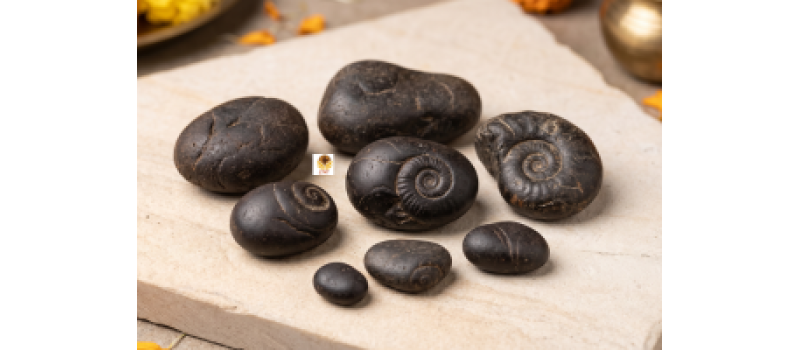
Most Shaligrams are black or
dark grey, round or oval, and small enough to sit in your palm. Many have a
natural opening and spiral lines on the surface, which help identify the type.
The Story of Shaligram and Tulsi
The Puranas tell the Shaligram
story in a few different versions. A well-known one appears in the Devi
Bhagavata Purana and the Brahmavaivarta Purana. Tulsi, a devoted wife,
discovers that Lord Vishnu has deceived her. In her grief, she curses him to
become a stone. Vishnu accepts the curse and says he will live as a rocky
mountain on the banks of the Gandaki River, and that the stones from that
mountain will be worshipped as his form. Tulsi's body becomes the Gandaki
River, and the Tulsi plant grows from her hair.
This story is why Tulsi leaves
are always offered to Shaligram. It is also why many families perform Tulsi
Vivah, the symbolic marriage of the Tulsi plant with Shaligram, in the month of
Kartik around Prabodhini Ekadashi.
The practice is very old. Adi
Shankaracharya refers to Vishnu worship in the Shaligram in his commentaries,
including on the Brahma Sutras, so it was well established more than a thousand
years ago.
Where Are Original Shaligram Stones Found?
By tradition, a true Shaligram
comes from the Kali Gandaki River valley in Mustang, in northern Nepal. The
Kali Gandaki is a tributary of the Gandaki River, which flows down into India
as the Gandak and joins the Ganga in Bihar.
.png)
Pilgrims search the riverbed
near places like Kagbeni, and many continue to Muktinath temple, which is
sacred to both Hindus and Buddhists. Buddhists call it Chumig Gyatsa, which
means "Hundred Waters". Damodar Kund, a glacial lake further north in
Upper Mustang, is also linked with Shaligrams, but entry to that area is
restricted.
Shaligrams are also becoming
harder to find. Researchers who study the pilgrimage report that melting
glaciers, changes in the river's course and gravel mining are reducing the
number of stones that surface each year. Nepal also does not allow large-scale
collection. In 2025, authorities in Mustang seized about 894 kg of Shaligrams
that were being taken away illegally. So if someone offers an unlimited supply
of "perfect" rare Shaligrams at very low prices, be careful.
What Is a Shaligram, Scientifically?
From a geology point of view, a
Shaligram is the fossil of an ammonite. Ammonites were sea creatures with
coiled shells, a bit like the nautilus we see today. They lived in an ancient
sea, called the Tethys, that once lay between the Indian landmass and Asia.
The Shaligram ammonites are
found in a black rock known as the Spiti Shales, which formed roughly 165 to
140 million years ago, in the Jurassic and early Cretaceous periods. Around 50
million years ago, the Indian plate pushed into Asia. This collision slowly
raised the Himalayas and lifted the old seabed, along with its fossils,
thousands of metres above sea level. Over time, the river cuts through these
rocks and the stones wash down into the Kali Gandaki.
Science explains how the stone
was formed. Faith explains why it is worshipped. The two do not need to
compete.
What Are Chakra Marks on a Shaligram Stone?
The spiral patterns on a
Shaligram are called chakras, because they look like the Sudarshan Chakra, the
discus held by Lord Vishnu. Scientifically, these spirals are the coiled shape
of the ammonite shell.
.png)
Traditional texts also describe
other features:
•
Vadana or mukha: a natural opening on the stone
that looks like a mouth.
•
Chakra: the spiral or wheel-like pattern, seen
inside the opening or on the surface.
•
Vanamala: a line or band on the stone, compared
to the garland of forest flowers that Vishnu wears.
•
Bindu: small dots or spots on the surface.
The number and position of
chakras, the size of the opening, the colour and the shape together decide the
type of Shaligram. That is why two stones that look alike to a beginner may be
identified as different forms by an experienced priest.
Main Types of Shaligram
Different texts sometimes describe
the same type in different ways, so treat the table below as a simple starting
point, not a final rulebook.
|
Type |
Form of Vishnu |
Traditional markings |
What devotees associate it with |
|
Lakshmi Narayan |
Lord Vishnu with Goddess Lakshmi |
One opening, four chakras and a vanamala; usually round and
dark like a rain cloud |
Prosperity and harmony in family life |
|
Narasimha |
Narasimha, the man-lion avatar |
Very large opening, two chakras, and lines that look like a
lion's mane |
Protection; traditionally said to need careful, regular
worship |
|
Sudarshan |
Vishnu's Sudarshan Chakra |
Often one chakra with a large opening; some texts describe
a green, shiny variety |
Protection from negativity |
|
Matsya |
Matsya, the fish avatar |
Long, fish-like shape with two chakras in the middle and
small dots |
Knowledge, since Matsya is said to have saved the Vedas |
|
Vasudeva |
Lord Vasudeva (Krishna) |
One or two chakras at the opening; described as light in
colour |
Peace and devotion |
|
Hiranyagarbha |
The golden source of creation |
Slightly long with golden lines, or round and black with
one chakra |
Growth and new beginnings |
The last column reflects
devotional belief, not proven effects. No honest seller should promise specific
results.
How to Identify a Real Shaligram Stone
Fakes are common. Some are
ordinary black stones with carved spirals. Some are fossils from other
countries, polished and sold as Gandaki Shaligrams. Some are dyed or coated to
look darker and shinier. A few simple checks help you avoid the obvious ones.
|
What to check |
Natural Shaligram usually shows |
Warning signs |
|
Surface |
Natural, uneven texture, worn smooth in places by river
water |
Too glossy or plastic-like; looks freshly polished all over |
|
Spiral marks |
Spirals follow the fossil's shape, with ridges that vary
naturally |
Marks look cut, too sharp, too regular, or sit only on the
surface |
|
Colour |
Black to dark grey, sometimes with brown or golden tones |
Colour rubs off on a damp white cloth, or patches look
painted |
|
Breaks and joins |
Natural cracks, chips and worn edges |
Glue lines, filled gaps, or pieces stuck together |
|
Seller details |
Clear photos of the actual stone, origin stated, honest
answers |
Stock photos, miracle promises, or very cheap prices for
"rare" types |
Some people suggest tapping the
stone to hear a metallic sound, or judging it by weight. These traditional
tests can give hints, but they are not reliable on their own. No single test
can prove that a Shaligram is genuine. For a costly stone, ask for detailed
photos from all sides and, if possible, get it checked by an experienced priest
or someone who knows fossils.
Which Shaligram Is Best for Home Worship?
For most families starting out,
one small, simple Shaligram is enough. Many priests suggest a Lakshmi Narayan
Shaligram for a household, because it represents Lord Vishnu together with
Goddess Lakshmi and is linked with a happy, balanced family life.
.png)
Shaligrams linked with fierce
forms, such as Narasimha, are traditionally treated with extra care. Many
families keep them only if someone at home can follow regular worship and the
rules strictly. A few practical points:
•
Size: a stone that fits comfortably in your palm
is easy to bathe and handle every day.
•
Condition: many families prefer a whole stone
with clear natural marks over a cracked one.
•
Family tradition: if your family follows a
particular sampradaya or has a family priest, ask them first. Their guidance
matters more than any general list.
If you are looking for a
Shaligram for your home puja, you can browse our Shaligram collection to see the stones
currently available.
How to Worship Shaligram at Home
Shaligram puja is simple.
Because the stone is considered swayambhu (self-manifested), most traditions
say it does not need pran pratishtha, the ritual usually done to invoke the
deity in a new murti. Many families begin on Ekadashi or a Thursday.
A simple daily routine:
1.
Bathe, then sit in a clean place facing east or
north-east.
2.
Bathe the Shaligram with clean water or Ganga jal. Many
families pour it from a shankh (conch).
3.
Wipe it gently with a soft cloth and place it on a
clean plate, cloth or small seat.
4.
Apply a little chandan (sandalwood paste).
5.
Offer fresh Tulsi leaves. Tulsi is considered the most
important offering for Shaligram.
6.
Light a diya and incense, and chant a simple mantra
such as "Om Namo Bhagavate Vasudevaya".
7.
Offer fruit, milk or a sweet as bhog, and finish with
aarti.
Where to keep Shaligram at home
Keep it in your puja room or a
clean, quiet corner, on a plate or seat. The Devi Bhagavata Purana warns
against placing a Shaligram directly on the ground, so avoid the bare floor.
Keep it away from the bathroom and avoid moving it without reason.
Who can worship Shaligram?
Scriptures differ here. Some
texts, such as the Padma Purana, restrict who may touch a Shaligram. Others,
such as a Skanda Purana verse often quoted in Vaishnava traditions, say
everyone may worship, including women. Many Vaishnava communities today welcome
all devotees. The safest path is to follow your family or guru's tradition.
What if you cannot do full puja every day?
Many priests advise that, on
busy days, you at least offer water and a Tulsi leaf with a short prayer. If
you will be away for long, ask a family member to continue.
A Note on Buying a Shaligram
Some devotees ask whether a
Shaligram should be bought at all. It is a fair question. The Padma Purana
speaks strongly against putting a price on a Shaligram, and in many families
stones are passed down or received as gifts from pilgrims.
At the same time, most devotees
cannot travel to Mustang themselves. When you buy from a seller, think of the
amount as covering the effort of sourcing, transport, cleaning and care, not
the value of the deity. From the day it arrives, treat it with full respect.
Buy an Original Shaligram Online
You now know more about
Shaligram than most buyers. Use that knowledge: ask for clear photos, ask about
the origin, and choose a type that suits your family's worship.
At Laxmi Narayan International, you can explore our Shaligram collection and other sacred items in our Shri Yantra, Shaligram, Sphatik and Parad range. If you are not sure which Shaligram suits your home, contact us before you buy and we will help you choose.
Frequently Asked Questions About Shaligram
What is Shaligram in English?
It is a sacred fossil stone
worshipped as Lord Vishnu. Scientifically, it is an ammonite fossil from
Nepal's Kali Gandaki River.
Which god is Shaligram?
Shaligram is worshipped as Lord
Vishnu. Different types are linked with different forms of Vishnu, such as
Lakshmi Narayan, Narasimha and Vasudeva.
Where should Shaligram be kept at home?
In a clean puja space, on a
plate, cloth or small seat, never directly on the floor.
Can women worship Shaligram?
Texts differ. Some restrict it,
while a Skanda Purana verse quoted in Vaishnava traditions allows everyone.
Follow your family or guru's tradition.
Does a Shaligram need pran pratishtha?
Most traditions say no, because
Vishnu is believed to be already present in it.
What are the benefits of keeping a Shaligram?
Devotees believe it brings
peace, protection and Lord Vishnu's blessings to the home. These are spiritual
beliefs, not guaranteed results.
How can I tell if a Shaligram is real?
Look for natural texture,
spirals that follow the fossil's shape, and colour that does not rub off. No
single test proves authenticity, so buy from a seller who shows the actual
stone.
How many Shaligrams can I keep at home?
One is enough. Customs about
keeping more differ, so ask your family priest.