
Shrawan Maas Complete Guide to Shiva Puja, Vrat, Festivals and Rituals
-800x350.jpg)
Shrawan Maas: The Complete
Guide to Shiva Worship, Vrat, Festivals and Rituals
Of all twelve months in the Hindu
calendar, Shrawan Maas holds a place apart. The moment it begins, temples fill
up, devotees wake before sunrise, and the sound of "Har Har Mahadev"
echoes everywhere. But what actually makes this month so special? Is it just
tradition, or is there something deeper going on?
The answer lies in the Puranas - Hindu
scriptures that connect this month directly to one of the most dramatic events
in mythology: the Samudra Manthan, when Lord Shiva drank the Halahal poison to
save the world. That act of supreme sacrifice happened during Shrawan, and ever
since, devotees have honored it by pouring water, milk, and Gangajal over the
Shivling to keep him cool.
In this guide, you will find everything
worth knowing - how to perform Shiva Abhishek step by step, how to correctly
offer Belpatra, the rules of Shravan Somwar vrat, the major festivals this
month brings, powerful mantras with their meanings, 20 do's, 20 don'ts,
traditional remedies, and the 15 most common mistakes people make in Shiva
worship.
Whether you are doing this for the first
time or you have been a devotee for years, there is something here for you.
What
This Guide Covers
•
What is Shrawan Maas?
•
Why is This Month Dedicated to Lord Shiva?
•
Scientific and Spiritual Significance
•
Shiva Abhishek - Complete Step-by-Step Guide
•
Belpatra: Why It Matters and How to Offer It
•
Shravan Somwar Vrat: Rules and Method
•
Major Festivals During Shrawan Maas
•
Powerful Shiva Mantras with Meanings
•
20 Do's During Shrawan Maas
•
20 Don'ts During Shrawan Maas
•
Effective Traditional Remedies (Upay)
•
15 Common Mistakes in Shiva Worship
•
15 Frequently Asked Questions
•
Conclusion
1.
What is Shrawan Maas?
Shrawan Maas is the fifth month in the
Hindu Vikram Samvat calendar. It falls roughly between July and August in the
Gregorian calendar, though the exact dates shift each year.
The name comes from the Nakshatra (lunar
constellation) called Shravana. During the full moon (Purnima) of this month,
the moon aligns with the Shravana constellation, and that is how the month got
its name. Some scholars also connect "Shravan" to the Sanskrit root
meaning "to listen" - pointing to this month as a time to listen to
scriptures and seek spiritual wisdom.
What
Makes This Month Significant?
The Shiva Purana, Skanda Purana, and
Linga Purana all specifically mention Shrawan Maas as a time when Shiva worship
yields greater spiritual benefit than in other months. This is not just oral
tradition - it is written in scripture.
There is also a natural dimension to
this. Monsoon transforms the landscape. Rivers rise, the earth turns green, and
the air itself feels different. Hindu philosophy is deeply tied to nature's
cycles, and this month's energy is considered aligned with Lord Shiva's own
nature.
2.
Why is Shrawan Maas Dedicated to Lord Shiva?
The
Samudra Manthan Connection
To understand Shrawan Maas, you have to
understand the Samudra Manthan - the churning of the cosmic ocean. According to
the Puranas, the Devatas (gods) and Asuras (demons) joined forces to churn the
ocean in search of Amrita, the nectar of immortality.
As they churned, many treasures emerged.
But along with the treasures came something terrifying: Halahal - a poison so
deadly that its fumes began scorching the three worlds. Both the gods and the
demons panicked. Neither could contain it. They went to Brahma and Vishnu for
help, and both directed them to Lord Shiva.
The
Story of Neelkanth
Lord Shiva agreed to help. He took the
Halahal poison and held it in his throat - neither swallowing it nor spitting
it out. His throat turned blue from the venom, and that is why one of his most
beloved names is Neelkanth, which literally means "blue throat."
This event is said to have occurred
during Shrawan Maas. To honor Shiva's sacrifice and to keep his throat cool,
devotees pour water, Gangajal, and milk over the Shivling throughout this
month. The ritual has a beautiful logic behind it.
What
the Puranas Say
The Skanda Purana specifically states that worshipping Lord Shiva during Shrawan Maas brings greater spiritual fruit than worship in any other month. The Shiva Purana also highlights Shravan Somwar - the Mondays of this month - as particularly auspicious. Monday is already associated with Shiva ("Somwar" comes from Soma, another name for the moon, which Shiva wears in his matted hair), so Shravan Mondays carry double significance.

3.
Scientific and Spiritual Significance
The
Spiritual View
Hindu spiritual tradition holds that
Shiva's energy is especially active and accessible during Shrawan Maas.
Practitioners of meditation and mantra often report that their focus is
sharper, their inner experiences more vivid, and their sense of peace more
settled during this time. Whether this is a result of heightened spiritual
energy or the discipline of the month's practices is a personal experience each
devotee holds.
The
Practical and Seasonal Perspective
Setting aside pure spirituality for a
moment, the traditions of Shrawan Maas also align well with the practical
realities of monsoon season:
•
Fasting (vrat) is a recognized Ayurvedic
practice during monsoon, when digestive strength is naturally lower.
•
Avoiding non-vegetarian food during this
season has hygiene roots - meat spoils faster in humid weather.
•
The emphasis on fresh herbs and offerings
like Belpatra connects to the fact that medicinal plants are at their most
potent during monsoon.
•
Morning worship encourages early rising,
which Ayurveda associates with better health during this season.
Note: These are two different lenses - one
spiritual, one practical. Neither cancels the other out.
4.
Shiva Abhishek: The Complete Step-by-Step Guide
Abhishek means ritual bathing. In Shiva
worship, it involves pouring sacred substances over the Shivling while chanting
mantras. It is one of the most direct and meaningful acts of devotion in Hindu
tradition.
Best
Time to Perform Abhishek
•
Brahma Muhurta (4:00 to 6:00 AM): Most
recommended. The mind is clear, the environment quiet, and the atmosphere is
considered spiritually charged.
•
Pradosh Kaal (twilight, around sunset): Also
highly auspicious for Shiva worship.
•
Shravan Somwar mornings: During this month,
Monday mornings carry special significance.
Note: If none of these times work for you,
worship whenever you can. Devotion matters more than perfect timing.
Preparation
•
Clean the Shivling and your worship space
first.
•
Wear clean clothes.
•
Gather all materials before you start.
• Take a Sankalp - a brief declaration of your name, intention, and purpose for the worship.
.jpg)
What to Offer and Why
What to offer and why:
- Plain
Water (Jal) - cools Lord Shiva's throat, the most basic and always
appropriate offering
- Gangajal
- the Ganga flows from Shiva's matted hair, making this the most sacred
water for Abhishek
- Milk
(Doodh) - symbolizes purity and coolness, offered to soothe Shiva after
the Halahal poison
- Curd
(Dahi) - represents fertility and abundance
- Honey
(Shahad) - symbolizes sweetness, the offering of devotion from the heart
- Ghee
- represents purity and spiritual prosperity
- Sugar
or Mishri - sweetness and auspiciousness
- Panchamrit
- all five mixed together: milk, curd, ghee, honey, and sugar. A complete
offering
- Belpatra
- Lord Shiva's most beloved offering (detailed in the next section)
- Dhatura
- traditionally offered to Shiva. Handle carefully as it is toxic
- Bhasma
or Vibhuti - sacred ash representing detachment and liberation
- White
flowers - Shiva is associated with purity; white flowers honor that
quality
- Rudraksha
- said to have emerged from Shiva's tears, deeply sacred to him
- Fruits
- natural offerings from the earth
- Incense
or Dhoop - purifies the atmosphere and creates a sacred space
- Oil
lamp (Diya) - represents knowledge, driving out spiritual darkness
Step-by-Step
Abhishek
•
Rinse the Shivling with plain clean water.
•
Pour Gangajal slowly while chanting "Om
Namah Shivaya."
•
Offer milk.
•
Offer curd.
•
Offer ghee.
•
Offer honey.
•
Offer sugar or Mishri.
•
Rinse once more with clean water.
•
Place Belpatra, white flowers, Dhatura
(carefully), and Vibhuti.
•
Light a lamp and incense.
•
Chant the Mahamrityunjaya Mantra or Om Namah
Shivaya.
• Close with Aarti.

5.
Belpatra: Why It Matters and How to Offer It
If you had to choose just one offering
for Lord Shiva, most scriptures would point to Belpatra - the leaf of the Bilva
tree. It holds a place in Shiva worship unlike any other item.
What
the Shiva Purana Says
The Shiva Purana states that offering a
single Belpatra to Shiva with true devotion equals the merit of performing an
Ashwamedha Yajna. That is a bold claim, and it is a spiritual statement rather
than a literal comparison. What it tells you is how seriously this leaf is
regarded in Hindu scripture.
The
Three-Leaf Symbolism
A single Belpatra has three lobes, and
this trifoliate shape is loaded with meaning:
•
The three aspects of Shiva: Creator,
Preserver, Destroyer.
•
The Hindu Trinity: Brahma, Vishnu, Mahesh.
•
Shiva's trishula (trident).
•
The three Gunas: Sattva, Rajas, Tamas.
When you offer a three-lobed Belpatra,
you are symbolically offering all of existence.
How
to Offer It Correctly
•
Wash the leaf before offering.
•
Place it with the smooth side facing down and
the rough, veined side facing up toward the Shivling. This is important and
often done backwards.
•
Remove or trim the stem before placing.
•
Do not offer leaves that are broken,
insect-eaten, or dried out.
•
Pick fresh leaves preferably in the morning.
Avoid picking leaves after sunset in traditional practice.
Common
Mistakes
•
Placing the smooth side up (incorrect).
•
Offering wilted or insect-damaged leaves.
•
Not washing the leaf.
•
Leaving a long stem attached.
•
Assuming any number of leaves is fine -
three-lobed leaves are specifically preferred.
6.
Shravan Somwar Vrat: Rules, Method and Precautions
Shravan Somwar refers to the Mondays
that fall during Shrawan Maas. Typically there are four or five of them, and
keeping a vrat (fast) on each is considered among the most meritorious
practices of the month.
How
to Observe the Vrat
•
Wake early, bathe, and set a Sankalp (your
intention for the fast).
•
Perform Shiva puja or Abhishek in the
morning.
•
Observe a fast through the day according to
your capacity.
•
Break the fast in the evening after Aarti.
Types of Fasting
- Nirjala - no food or water all day. The strictest form, for those in good health who can manage it
- Phalahar - only fruits, milk, and dry fruits. Most common and widely practiced
- Ek Vakt Bhojan - one sattvic meal during the day. Good for beginners or those with dietary needs
- Nirjala - no food or water all day. The strictest form, for those in good health who can manage it
- Phalahar - only fruits, milk, and dry fruits. Most common and widely practiced
- Ek Vakt Bhojan - one sattvic meal during the day. Good for beginners or those with dietary needs
Who Can Observe This Vrat?
Anyone can keep Shravan Somwar vrat -
men, women, married, unmarried, householders or students. There is no caste or
gender restriction in the scriptures. Those who are pregnant, elderly, or
managing health conditions should consult a doctor before fasting, and choose
the phalahar or single-meal option if needed.
Breaking
the Fast
The vrat is typically broken in the
evening after Shiva Aarti, with prasad or fruit. Some people keep it through
the night and break it after morning puja the next day. Both are valid - this
varies by regional practice.
7.
Major Festivals During Shrawan Maas
Note: Dates can vary by region due to
differences between the Purnimant and Amant calendar systems used in North and
South India respectively.
Shravan
Somwar
As described above, each Monday of this
month is a festival in itself - a day of Shiva worship, fasting, and temple
visits.
Nag
Panchami
Observed on Shravan Shukla Panchami,
this is a festival dedicated to serpent deities (Nagas). Serpents hold deep
significance in Hindu tradition - Shiva wears one around his neck, and Vishnu
rests on Adishesha. On this day, snake idols are worshipped and offered milk. A
practical note: offering milk to actual snakes is biologically harmful to them.
Offering to a Naga idol is the more recommended practice.
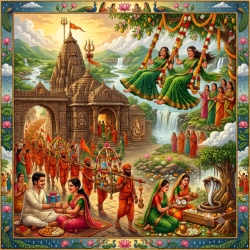
Hariyali
Teej
Falling on Shravan Shukla Tritiya,
Hariyali Teej is associated with the reunion of Goddess Parvati and Lord Shiva.
Women - both married and unmarried - celebrate with fasting, singing, and
swings (jhula). Green clothing is worn to honor the monsoon season's lush
greenery. It is a joyful, vibrant festival.
Putrada
Ekadashi
On Shravan Shukla Ekadashi, this fast is
associated with Lord Vishnu and is especially significant for those seeking
blessings for children and family wellbeing. The word Putrada means "one
who grants a son" but the broader intent is family prosperity and divine
grace.
Raksha
Bandhan
Observed on Shravan Purnima - the full
moon day - Raksha Bandhan celebrates the bond between brothers and sisters. The
sister ties a rakhi on her brother's wrist, and he pledges to protect her. In
coastal Maharashtra, this day is also Narali Purnima, when fishermen offer
coconuts to the sea.
Krishna
Janmashtami
Lord Krishna's birth anniversary falls
either within Shrawan Maas or in Bhadrapada depending on the regional calendar
system. In South India it is often in Shravan, while North India places it in
Bhadrapada. It is celebrated with midnight pujas, dahi handi events, and
devotional singing across the country.
8.
Powerful Shiva Mantras with Meanings
Om
Namah Shivaya (Panchakshari Mantra)
Om Namah Shivaya
Meaning: "I bow to Lord Shiva"
or more deeply, "I surrender my ego to Shiva." The five syllables
Na-Ma-Shi-Va-Ya correspond to the five elements - earth, water, fire, air, and
space. This is the most universally chanted Shiva mantra. You can chant it
anywhere, anytime, in any state.
Mahamrityunjaya
Mantra
Om Tryambakam Yajamahe, Sugandhim Pushtivardhanam, Urvarukamiva
Bandhanan, Mrityor Mukshiya Maamritat
Meaning: "We worship the three-eyed
Lord Shiva who is fragrant and nourishes all beings. As a cucumber is freed
from its vine, may he free us from death - not for immortality, but for
liberation."
This is one of the oldest mantras in the
Rig Veda. It is chanted for health, protection, and liberation from suffering.
For Abhishek during Shrawan Maas, chanting this 108 times (one mala) is a
deeply meaningful practice.
Rudra
Gayatri Mantra
Om Tatpurushaya Vidmahe, Mahadevaaya Dhimahi, Tanno Rudrah
Prachodayat
Meaning: "Let us know Tatpurusha
(Shiva). Let us meditate on Mahadeva. May Rudra inspire and guide our intellect
in the right direction."
This is chanted during formal worship
for clarity of mind and spiritual direction.
When to Chant
Om Namah Shivaya -
anytime throughout the day, for general devotion and peace
Mahamrityunjaya - Brahma Muhurta or evening, 108
repetitions, for health and protection
Rudra Gayatri - during formal puja, for clarity and
spiritual guidance
Om Namah Shivaya -
anytime throughout the day, for general devotion and peace
Mahamrityunjaya - Brahma Muhurta or evening, 108
repetitions, for health and protection
Rudra Gayatri - during formal puja, for clarity and
spiritual guidance
9.
Do's During Shrawan Maas (20 Points)
•
Pour water or Gangajal on the Shivling every
Monday, ideally daily.
•
Try to wake during Brahma Muhurta (4 to 6 AM)
for meditation or prayer.
•
Offer fresh, clean Belpatra - three-lobed,
washed, smooth side down.
•
Chant Om Namah Shivaya or Mahamrityunjaya
Mantra every day.
•
Eat sattvic food - fresh, light, vegetarian.
Avoid onion and garlic especially on puja days.
•
Speak truthfully. Truthfulness is considered
a form of tapas (austerity).
•
Give in charity - food, clothing, or money to
those in need.
•
Read or listen to the Shiva Purana, Shiv
Chalisa, or Shiva Aarti.
•
Visit a Shiva temple, especially on Mondays.
•
Practice sitting meditation, even 10 to 15
minutes daily.
•
Practice moments of silence (maun) - even one
quiet hour helps.
•
Bring fresh flowers for puja - white flowers
are especially appreciated by Lord Shiva.
•
Keep your home and worship space clean and
organized.
•
Pray together as a family at least on
Mondays.
•
Attend or listen to Rudrabhishek if possible
at your local temple.
•
Light a lamp every evening near your prayer
space or tulsi plant.
•
Wear clean clothes for puja - a physical act
of respect.
•
Chant Shiva Panchakshara Stotra during or
after Abhishek.
•
Practice gratitude at the end of each day - a
short acknowledgment of Shiva's presence.
•
Keep a journal of your spiritual practice
this month to build consistency.
10.
Don'ts During Shrawan Maas (20 Points)
•
Avoid meat, fish, and eggs throughout the
month. Sattvic diet is the norm during Shrawan.
•
Avoid alcohol completely.
•
Avoid onion and garlic, especially on Mondays
and puja days.
•
Do not lie or deceive - tapasya includes
honesty, not just fasting.
•
Avoid anger, especially during and after
puja.
•
Do not speak ill of others or gossip - this
is considered particularly inauspicious this month.
•
Do not offer insect-eaten, broken, or wilted
Belpatra.
•
Do not use your phone during puja - focus is
the whole point.
•
Do not leave your worship space dirty or
neglected.
•
Do not consume the milk or water used in
Abhishek - it is offered to the deity and should be drained properly.
•
Do not offer Tulsi to Shiva. Tulsi belongs in
Vishnu and Krishna worship. The Shiva Purana has a specific katha about this.
•
Do not apply kumkum (sindoor) directly to a
plain Shivling without understanding the tradition - practices vary and
applying it incorrectly can be seen as inauspicious.
•
Do not install a Shivling at home unless you
are committed to daily puja. Once installed, neglect is not an option.
•
Do not sleep during the day if you are
keeping a strict vrat - some traditions consider this breaks the fast.
•
Do not touch Dhatura (a traditional offering)
carelessly - it is toxic. Wash hands thoroughly after handling.
•
Do not pick a fight or carry resentment on
Mondays - the spirit of the vrat includes peace in relationships.
•
Do not perform Abhishek with dirty, stale, or
tap water that is heavily chlorinated if Gangajal is available instead.
•
Do not worship out of fear or superstition.
Puja is an act of love, not a transaction.
•
Do not show off your worship on social media
during the puja itself. Document after if you want to share - but be present
during.
•
Do not skip the Aarti or leave puja
half-done. Complete what you begin.
11.
Effective Traditional Remedies (Upay)
Note: These are devotional practices, not
guarantees. They work by shifting your inner state - which then naturally
influences your outer life.
For
Peace of Mind
•
Chant the Mahamrityunjaya Mantra 108 times
every morning during this month.
•
Read or listen to Shiv Chalisa daily.
For
Spiritual Growth
•
Participate in Rudrabhishek at your local
temple, or do a home version with full focus.
•
Read one chapter of the Shiva Purana each
day.
For
Clearing Negativity
•
Sprinkle Gangajal in your home, especially
corners and entrances.
•
Light dhoop (incense) or do a small havan
(fire offering) to purify the space.
For
Family Harmony
•
Pray together as a family on Monday evenings.
Simple shared prayer has more power than solo worship done in frustration.
•
Visit a Shiva temple together, offer Belpatra
and water, and speak kindly to each other afterward.
For
Career Focus
•
Chant Om Namah Shivaya before starting your
workday. It centers your attention.
•
Pair your mantra practice with clear
intentions - not magic thinking, but focused clarity.
For
Financial Discipline
•
Shrawan Maas is a good time to reduce
unnecessary spending. The energy of tapas - restraint - applies to money too.
•
Whatever you save, set aside something for
charity. Even a small amount given with sincerity counts.
For
Health Prayers
•
The Mahamrityunjaya Mantra is specifically
associated with health and healing in Hindu tradition.
•
Pray for health while also staying consistent
with medical care. Spirituality and medicine work together.
12.
Common Mistakes in Shiva Worship
•
Offering Belpatra with the smooth side up
instead of down.
•
Using broken, wilted, or insect-damaged
Belpatra.
•
Offering Tulsi leaves to Shiva - a mistake
rooted in mixing up deity-specific traditions.
•
Drinking or using the Abhishek milk for
cooking - it is prasad only in the sense that it was offered; it should be
drained, not consumed.
•
Doing puja while distracted - glancing at
your phone mid-Abhishek cancels the meditative benefit.
•
Using stale or unclean water for Abhishek.
•
Scrubbing the Shivling harshly - clean it
gently.
•
Leaving the worship space dirty after puja.
•
Mispronouncing mantras without making any
effort to learn the correct pronunciation.
•
Performing puja as performance - for others
to see - rather than as sincere devotion.
•
Handling Dhatura without washing hands
afterward - it is toxic.
•
Installing a Shivling at home without knowing
the responsibility of daily worship it requires.
•
Offering Ketaki (Kewda) flowers to Shiva -
these are specifically excluded by Puranic tradition.
•
Leaving puja half-done or skipping the Aarti.
•
Believing that one grand act of worship
compensates for year-round neglect - consistency is what the tradition values.
13.
Frequently Asked Questions
Q1. Can women perform Shiva Abhishek?
Yes, completely. There is no scriptural
restriction on women performing Shiva Abhishek. Both the Agama Shastra and
Shiva Purana describe female devotees worshipping Shiva. Some regional customs
may vary, but across Hindu tradition broadly, women have always been and
continue to be central to Shiva worship.
Q2. Can Belpatra be reused the next day?
The preference is always fresh Belpatra.
That said, some scriptural references suggest that Belpatra retains its
sanctity and can be re-offered after washing. In practice, if fresh Belpatra is
not available, a washed leaf from the previous day is accepted by most
traditions. Fresh is always better when possible.
Q3. Can Tulsi be offered to Shiva?
No. Traditionally, Tulsi is not offered
to Lord Shiva. The Shiva Purana contains a story explaining this. Tulsi is
considered sacred to Lord Vishnu and Krishna, and offering it to Shiva is
generally avoided in Hindu worship.
Q4. Can the Shivling be touched by
devotees?
At home, yes. If you have a Shivling at
home, you can touch and clean it as part of your worship. At temples, the rules
vary. In many temples, only the priests touch the Shivling. Follow the specific
rules of the temple you visit.
Q5. Can the milk from Abhishek be consumed?
No. Milk used in Abhishek has been
offered to the deity and is considered nirmalyam (offered substance). It should
be drained - ideally into the earth near a tulsi plant or in the temple drain.
Do not use it for cooking or drinking.
Q6. Can fasting be partial during Shravan
Somwar?
Yes. Fasting is not one-size-fits-all.
Those who cannot keep a full fast can observe phalahar (fruits and milk only)
or eat one sattvic meal during the day. The intention and devotion behind the
fast matter more than the exact form it takes.
Q7. Which mantra is best for Shrawan Maas?
No single mantra is objectively
"best." Om Namah Shivaya is universally accessible and can be chanted
anytime. The Mahamrityunjaya Mantra is recommended specifically for health,
protection, and healing. The Rudra Gayatri is ideal during formal puja. Choose
whichever resonates and practice it consistently.
Q8. Which flowers should not be offered to
Shiva?
Ketaki (Kewda) flowers are specifically
excluded from Shiva worship based on a Puranic story. Otherwise, white flowers
are most preferred. Red flowers are generally offered to goddess forms (Shakti)
rather than Shiva. When in doubt, white is a safe and meaningful choice.
Q9. Can Abhishek be done at home?
Absolutely. You can keep a Shivling at
home and perform Abhishek yourself. Use clean water, Gangajal if available,
milk, and other items you have. The home puja is just as valid as a temple
visit when done with sincerity.
Q10. How do I start Shiva worship for the
very first time?
Start simple. Take a glass of clean
water, say "Om Namah Shivaya" from the heart, and pour it over a
Shivling. That is a complete act of devotion. Build your practice from there -
add Belpatra, then milk, then more mantras as you learn. There is no pressure
to be perfect from day one.
Q11. When should I start Shravan Somwar
vrat?
Begin with the first Monday of Shrawan
Maas and observe all the Mondays of the month. If you plan to continue it as an
ongoing practice (some devotees observe 16 consecutive Shravan Somwar across
multiple years), consult a local pandit for the appropriate Sankalp.
Q12. Is home worship as effective as temple
worship?
From a scriptural standpoint, the
sincerity of the devotee matters more than the location. Home puja is valid and
meaningful. That said, temples carry a long tradition of energy, community, and
proper ritual - so both have their unique value.
Q13. What is the difference between
Rudrabhishek and regular Abhishek?
Rudrabhishek is an elaborate, formal
ritual in which the Sri Rudram (from the Yajurveda) or Rudrashtadhyayi is
chanted by a trained priest while Abhishek is performed simultaneously. It is a
longer and more involved ceremony. Regular home Abhishek is simpler and done by
the devotee themselves. Both are valid - Rudrabhishek is recommended for
special occasions or milestone prayers.
Q14. Are there any travel restrictions
during Shrawan Maas?
No. There are no scriptural travel
restrictions during Shrawan Maas. If you are traveling, try to find a Shiva
temple along the way for a quick darshan on Mondays. The devotion travels with
you.
Q15. Can Shiva worship be done by people of
all backgrounds?
Yes. Shiva is called
"Bholenath" - the simple one, the one who is easily pleased. He is
worshipped across all communities, regions, and backgrounds. There are no caste
or community restrictions on who can worship Lord Shiva.
14.
Conclusion
Shrawan Maas is one of those rare
intersections where mythology, nature, and personal practice come together in a
way that actually makes sense. The story of Shiva holding the Halahal poison is
not just a good story - it is a symbol of the capacity to absorb pain for the
sake of others. When we pour water over the Shivling, we are participating in
that symbolism.
The do's and don'ts of this month are
not arbitrary rules. They point toward a simpler, quieter, more honest way of
living - even if just for a few weeks. Sattvic food, honest speech, regular
prayer, acts of generosity. These are not sacrifices. They are adjustments
that, if practiced consistently, tend to make people feel better and think more
clearly.
Lord Shiva is called Bholenath for good
reason. He is not waiting for an elaborate ceremony or a perfectly pronounced
mantra. A glass of clean water offered with a genuine heart is enough to begin.
From there, the practice grows at its own pace.
Observe this Shrawan Maas not out of
fear or superstition, but out of a genuine desire to connect with something
larger than your daily concerns. That is what the month is meant for.
Har Har Mahadev